Cyber Insurance Requirements for Small Businesses: Coverage Limits and Underwriting Criteria
A comprehensive guide to small business cyber insurance, detailing first-party versus third-party liabilities, underwriting security controls, pricing factors, and claim procedures.
Understanding Small Business Cyber Risk and Insurance
Small organizations increasingly rely on digital networks, cloud services, and online payment systems to conduct daily operations. While technology improves operational efficiency, it also exposes firms to digital threats such as ransomware, business email compromise, and network intrusion. Federal agencies note that small businesses are frequent targets for cyberattacks because smaller operations often lack the dedicated security infrastructure of larger enterprises (Source 1). Cyber insurance serves as a financial risk transfer mechanism, helping companies manage costs associated with data breaches, systems restoration, and legal defense.
Securing commercial cyber coverage requires meeting strict underwriting criteria. Insurers no longer issue policies based solely on high-level questionnaires. Modern underwriting evaluates an organization's internal controls, patch management, access restrictions, and incident response readiness. Understanding these evaluation metrics helps business owners select appropriate coverage limits while maintaining required security baselines.
Distinguishing First-Party Losses vs. Third-Party Liabilities
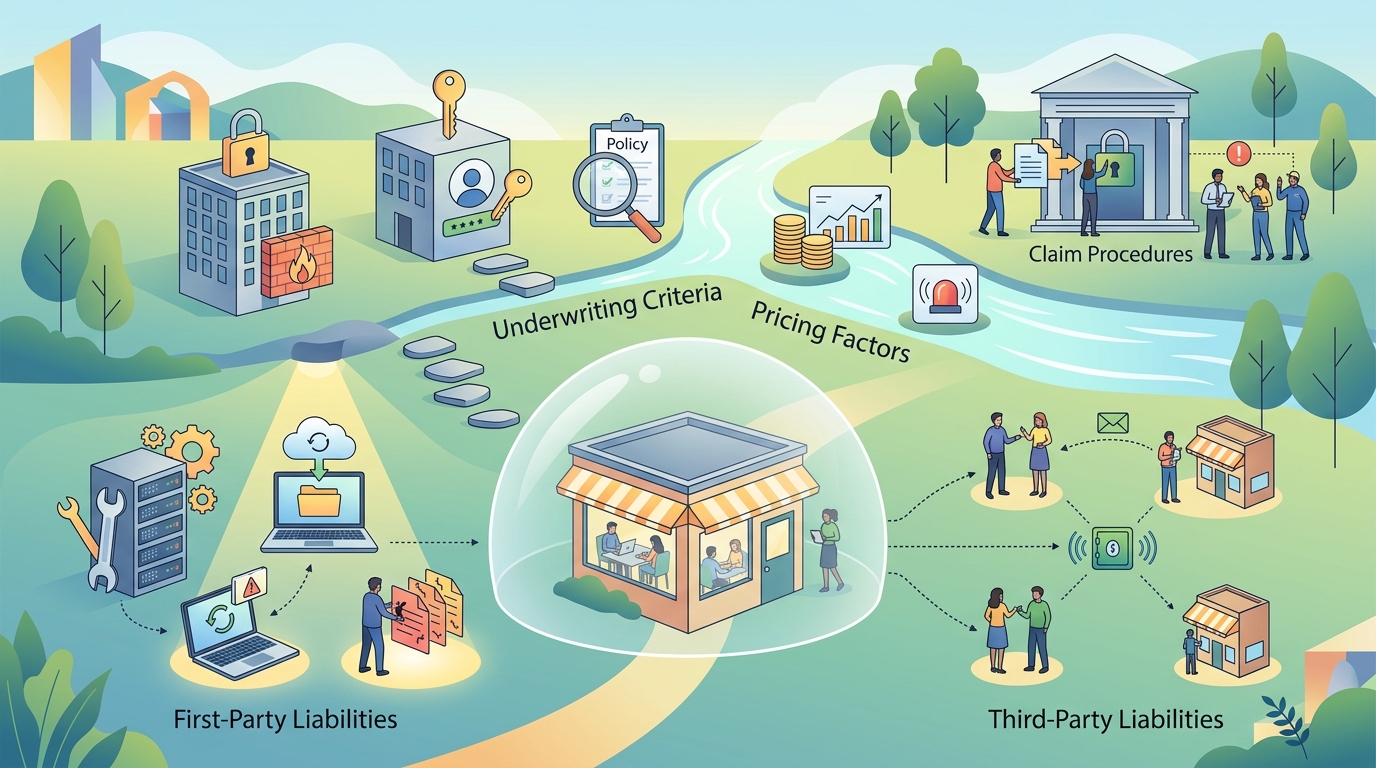
Commercial cyber insurance policies divide coverage into two primary categories: first-party coverage and third-party liability coverage. First-party coverage addresses direct financial costs incurred by the policyholder following an incident. Third-party coverage protects the business if customers, vendors, or regulators file lawsuits or issue fines due to a security failure.
| Coverage Type | Included Expenses | Typical Scenario |
|---|---|---|
| First-Party Coverage | Data restoration, forensic investigation, extortion payments, business interruption loss, crisis communications. | A ransomware attack encrypts local servers, halting sales operations for five days. |
| Third-Party Liability | Legal defense fees, settlement costs, court judgments, regulatory fines, customer notification services. | Clients sue a firm after their sensitive personal information is leaked online. |
Federal guidance recommends securing both systems and sensitive data, as a single incident often triggers both first-party remediation costs and third-party liabilities (Source 1). For example, if a firm experiences a breach, it must pay computer forensic teams to isolate the intruder (first-party) while simultaneously notifying affected clients and managing potential class-action litigation (third-party).
Mandatory Security Controls Required by Underwriters
Underwriters use technical audits to verify that an applicant maintains adequate security hygiene before issuing a policy. Missing key controls can result in denied applications, reduced coverage limits, or higher deductibles. Recommended federal security practices directly mirror these common insurer mandates (Source 1).
- Multi-Factor Authentication (MFA): Require MFA across all remote network access, email accounts, and administrative portals. Insurers often decline applicants who lack MFA on cloud email systems.
- Automated Off-Site Backups: Maintain isolated, encrypted, and regularly tested data backups. Backups must be stored offline or in write-once-read-many (WORM) cloud repositories to prevent ransomware from wiping backup files (Source 1).
- Endpoint Detection and Response (EDR): Deploy centralized EDR software on all workstations and servers to detect anomalous behavior and isolate compromised devices in real time.
- Patch and Vulnerability Management: Apply critical software updates and security patches promptly. High-severity software vulnerabilities must typically be patched within 14 to 30 days of release (Source 1).
- Employee Security Awareness Training: Conduct periodic phishing simulations and cyber hygiene training for staff to reduce human error vectors (Source 1).
Small Business Cyber Insurance Cost Factors
The cost of small business cyber insurance varies based on annual revenue, industry risk profile, the volume of sensitive records stored, and overall security posture. A boutique consulting firm handling basic client contact details pays significantly lower premiums than a healthcare clinic managing thousands of confidential medical records.
According to commercial insurance market benchmarks, annual premiums generally track with an organization's size, operational reliance on cloud networks, and data sensitivity tier.
| Industry Risk Level | Annual Revenue Range | Typical Coverage Limit | Estimated Annual Premium |
|---|---|---|---|
| Low Risk (Professional Services) | Under $1 Million | $1,000,000 | $600 – $1,200 |
| Moderate Risk (E-Commerce / Retail) | $1 Million – $5 Million | $1,000,000 – $2,000,000 | $1,500 – $3,500 |
| High Risk (Healthcare / Finance) | $5 Million – $10 Million | $2,000,000 – $5,000,000 | $4,500 – $10,000+ |
Implementing robust technical controls—such as full-disk encryption and strict access privileges—can help lower premium rates within these industry ranges (Source 1). Policyholders who agree to higher deductibles also lower their annual premium costs.
Common Cyber Insurance Policy Exclusions
Business owners must review policy exclusion clauses to understand where coverage ends. Insurers specify explicit conditions under which claims will be denied or payout limits reduced.
- Unpatched Vulnerabilities: Claims may be denied if an attack exploited a known software security hole that the organization failed to patch after official manufacturer warnings (Source 1).
- State-Sponsored Cyberattacks: Many policies include war and terrorism exclusions that disclaim coverage for nation-state cyber warfare, though legal definitions of state attribution remain subject to court disputes.
- Wire Fraud and Human Error Failures: Social engineering, such as fraudulent funds transfer requests, often requires a specific policy endorsement rather than standard cyber liability coverage.
- Unencrypted Laptops and Mobile Devices: Loss or theft of portable devices containing unencrypted sensitive data may invalidate first-party loss coverage (Source 1).
- Prior Known Acts: Incidents or network compromises that began prior to the policy's retroactive inception date are excluded.
Step-by-Step Ransomware and Incident Claim Process
When a security incident occurs, following proper claim protocols helps maintain policy compliance and ensures maximum financial recovery. Insurers enforce strict notification deadlines, often requiring notice within 24 to 48 hours of detecting an breach.
- 1. Isolate Affected Systems: Immediately disconnect infected servers and workstations from the local network and internet to prevent lateral threat movement. Do not turn off power, as volatile RAM memory holds vital forensic evidence (Source 1).
- 2. Notify Insurance Claims Panel: Contact the insurer's designated emergency hotline. Avoid hiring independent IT vendors or paying ransom demands before receiving approval from the insurer's breach coach.
- 3. Engage Approved Breach Counsel: Work with legal counsel provided by the insurer. Attorney-client privilege protects forensic reports and internal investigation findings from early legal discovery.
- 4. Document Financial Losses: Maintain clear records of all operational downtime, employee overtime fees, equipment replacement costs, and lost revenue associated with system outages.
- 5. File Law Enforcement Reports: Report the incident to relevant authorities such as local law enforcement or the FBI Internet Crime Complaint Center (IC3) to fulfill statutory requirements.
Regulatory Compliance and Legal Liabilities
Beyond physical system repair, data security failures introduce statutory compliance obligations. Federal guidelines stress that organizations must protect consumer personal information under applicable state and federal privacy acts (Source 1). Mandatory breach notification laws in all 50 U.S. states mandate specific timelines for informing affected individuals and state attorneys general after discovering unauthorized access.
Standard general liability policies typically exclude digital data losses, leaving dedicated cyber insurance as the primary vehicle to fund mandatory notification services, credit monitoring for victims, legal defense against regulatory enforcement, and statutory fines.
Does standard business property insurance cover cyberattacks?
Standard commercial property and general liability policies generally exclude digital data loss, network outages, and extortion payments. Business owners typically require a dedicated cyber insurance endorsement or standalone policy.
What security requirement is most frequently mandated by insurers?
Multi-factor authentication (MFA) across all remote access points and email systems is the single most common security control required by commercial insurance underwriters today.
Will cyber insurance pay a ransomware demand directly?
Coverage depends on policy terms and regulatory restrictions. Most insurers require policyholders to attempt data recovery from backups first (Source 1) and consult legal breach counsel prior to negotiating or sending funds.
Sources
- Cybersecurity for Small Business — Federal Trade Commission
This article is for general information only and is not professional advice. Figures come from public sources and change over time; check the official source before you act.
More from Inside Life Digest
- Gap Insurance Cost Breakdown: Pricing, Depreciation Curves, and When Coverage Is Necessary
- Long-Term Care Insurance Cost Breakdown: Premiums, Elimination Periods, and Benefit Triggers
- Evaluating Private Student Loan Refinancing: Interest Rate Mechanics, Federal Protection Losses, and Savings Calculus
- Comprehensive Travel Insurance: Medical Evacuation, Cancellation, and Pre-Existing Condition Waivers
- Revocable Living Trust vs. Will: Cost, Probate Avoidance, and Asset Transfer Rules
- Cyber Insurance Requirements for Small Businesses: Coverage Limits and Underwriting Criteria