HELOC vs. Cash-Out Refinance: Costs, Tax Rules, and Repayment Risks
An objective financial breakdown comparing HELOCs and cash-out refinances, detailing closing costs, variable rate risks, IRS tax rules, and loan-to-value limits.
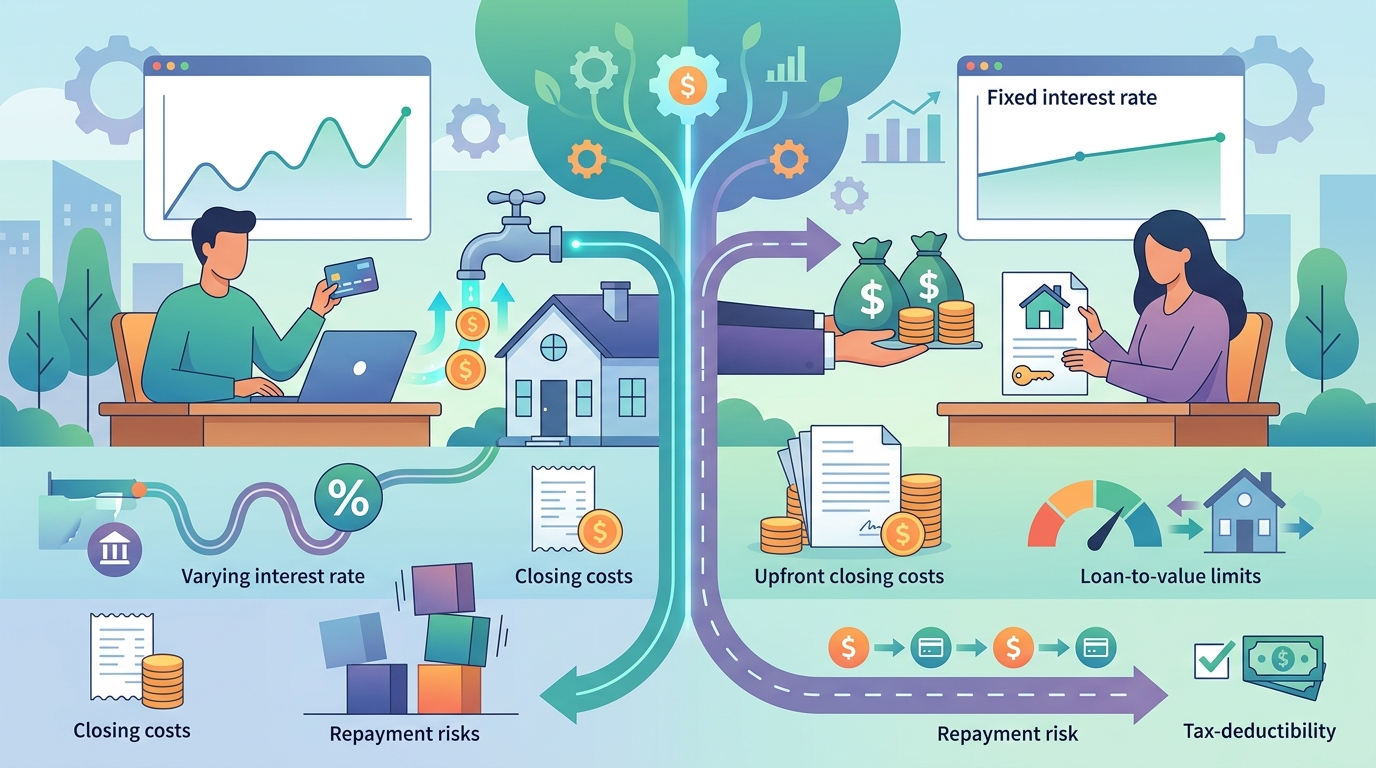
Understanding Home Equity Access: HELOC vs Cash-Out Refinance
Homeowners seeking capital for major expenditures, such as home improvements or debt consolidation, frequently evaluate two primary financial instruments: a Home Equity Line of Credit (HELOC) or a cash-out refinance. Both options leverage built-up home equity, but they differ fundamentally in structure, interest rate mechanics, fee schedules, and repayment obligations.
A HELOC functions as a revolving line of credit secured by the borrower's home (Source 1). Much like a credit card, a HELOC allows borrowers to draw funds up to a predetermined limit, repay the principal, and draw again during an initial access window known as the draw period (Source 1). In contrast, a cash-out refinance replaces an existing primary mortgage with an entirely new, larger mortgage. The homeowner receives the difference between the new mortgage balance and the original balance in a single cash payout at closing.
Choosing between a HELOC vs cash out refinance requires analyzing how each instrument alters a home's debt profile, short-term cash flow, and long-term borrowing costs. Every decision must weigh immediate expenses against long-term financial commitments, including how interest rates are calculated and how lenders evaluate collateral.
Upfront Closing Costs and Initial Fee Schedules
The upfront expense of securing capital differs substantially between these two credit facilities. Because a cash-out refinance creates a brand-new primary mortgage, it requires a complete underwriting process. Consequently, cash out refinance closing costs typically range between 2% and 6% of the new total loan amount, according to standard mortgage fee schedules published by commercial lenders.
These closing costs cover multiple administrative and legal requirements, including loan origination fees, home appraisal fees, title searches, title insurance policies, government recording fees, and underwriting charges. For example, refinancing a $300,000 balance into a $350,000 cash-out mortgage could yield upfront fees between $7,000 and $21,000, which are often rolled into the new principal balance or paid directly out-of-pocket.
By contrast, HELOCs generally feature significantly lower initial outlays. Many financial institutions offer HELOC products with minimal or no upfront closing costs (Source 1). When fees do apply, they are typically limited to baseline administrative items such as a home appraisal fee, an application fee, or a nominal title verification fee. However, some HELOC structures may incorporate ongoing maintenance charges, such as an annual account fee or an early cancellation penalty if the line is closed within a specific timeframe, such as two to three years (Source 1).
| Fee Component | HELOC | Cash-Out Refinance |
|---|---|---|
| Typical Upfront Costs | 0% to 2% of credit line | 2% to 6% of total loan amount |
| Underwriting Scope | Second-lien evaluation | Full primary mortgage underwriting |
| Appraisal Requirement | Drive-by, automated, or full appraisal | Full interior/exterior appraisal |
| Title Insurance | Minimal or lender-waived | Full lender title insurance required |
| Ongoing Maintenance Fees | Possible annual fee (e.g., $50-$100) | None (included in principal/interest) |
Interest Rate Mechanics: Variable vs. Fixed Rate Structures
The structure of interest charges represents one of the most critical operational distinctions between a revolving line and a full mortgage replacement. Evaluating home equity loan rates requires an understanding of how benchmark indexes dictate monthly cash obligations.
HELOCs usually carry variable interest rates tied to a publicly traded index, most commonly the U.S. Prime Rate (Source 1). The rate charged to the borrower equals the index plus a margin set by the lender based on creditworthiness. Because the rate is variable, interest charges fluctuate over time in response to central bank policy shifts and broader market conditions (Source 1). During periods of monetary tightening, monthly payments on an outstanding HELOC balance can rise rapidly.
A cash-out refinance, conversely, typically utilizes a fixed-rate structure for the duration of the 15-year or 30-year term. Once the mortgage contract is finalized, the interest rate remains unchanged regardless of macroeconomic fluctuations. This provides complete payment predictability for the life of the loan.
Borrowers considering a HELOC must carefully review the rate adjustment rules detailed in the loan agreement. Standard contracts outline how frequently the rate can adjust, the maximum rate ceiling over the life of the loan, and any periodic rate caps that limit how much the interest rate can increase within a single adjustment period (Source 1).
IRS Tax Deductibility Rules for Home Equity Interest
Understanding tax implications is central to evaluating the net cost of borrowing. A common question among property owners is whether is HELOC interest tax deductible under current federal tax code provisions. According to IRS Publication 936, the rules governing interest deductibility apply uniformly to both HELOCs and cash-out refinances (Source 2).
Under the Tax Cuts and Jobs Act regulations detailed in IRS Publication 936, mortgage interest—including interest on secondary financing or refinanced debt—is deductible only if the borrowed funds are used to buy, build, or substantially improve the qualified home that secures the loan (Source 2). The IRS defines a substantial improvement as an expenditure that adds value to the home, prolongs its useful life, or adapts it to new uses (Source 2). Capital additions such as building a room extension, replacing a roof, or installing central HVAC systems generally qualify.
If a homeowner uses proceeds from a HELOC or cash-out refinance for personal expenses—such as paying off credit card balances, purchasing a vehicle, or funding college tuition—the interest associated with those funds is not tax-deductible under federal rules (Source 2).
- Qualifying Use: Adding a bathroom, replacing a roof, or remodeling a kitchen preserves potential interest deductibility (Source 2).
- Non-Qualifying Use: Consolidating unsecured debt, funding vacations, or paying tuition eliminates interest deductibility for that portion of the loan (Source 2).
- Tracing Requirement: Taxpayers must maintain detailed receipts, contractor contracts, and bank records to trace every dollar of drawn capital directly to home improvement expenditures (Source 2).
Additionally, total mortgage debt limits apply. IRS Publication 936 specifies that for debt incurred after December 15, 2017, homeowners may deduct interest on up to $750,000 of qualifying home equity debt ($375,000 if married filing separately) across their primary and secondary residences combined (Source 2). Debt incurred prior to that date falls under an older $1,000,000 ceiling ($500,000 for married filing separately) (Source 2).
Impact on Loan-to-Value (LTV) Ratios and Equity Margins
Lenders measure risk exposure by assessing the home's total debt relative to its appraised market value. This evaluation relies on two primary metrics: Loan-to-Value (LTV) and Combined Loan-to-Value (CLTV).
For a cash-out refinance, lenders look strictly at the LTV ratio, calculated by dividing the new primary mortgage balance by the current appraised home value. Conventional mortgage underwriting guidelines generally cap cash-out refinances at an 80% LTV threshold. For example, if a home appraises at $400,000, the maximum allowable primary mortgage balance after cashing out would be $320,000 ($400,000 multiplied by 0.80).
For a HELOC, lenders evaluate the CLTV ratio, which sums the existing primary mortgage balance and the maximum authorized HELOC credit limit, then divides that sum by the appraised property value. Many institutions permit a maximum CLTV between 80% and 85%, though select lenders may allow higher limits for borrowers with exceptional credit profiles.
Consider a home appraised at $500,000 with an existing primary mortgage balance of $250,000. An 85% maximum CLTV ceiling allows total secured debt up to $425,000 ($500,000 multiplied by 0.85). Subtracting the existing $250,000 first mortgage leaves a maximum allowable HELOC credit line of $175,000.
Step-by-Step Decision Framework Based on Need and Timeline
Selecting the appropriate equity extraction vehicle requires matching the capital disbursement model and interest structure to your specific financial situation. Below is a structured four-step evaluation process.
Step 1: Define the Outlay Timeline
Determine whether you require a single cash lump sum or recurring access to capital over several years. Major single-event expenses—such as purchasing a second property or executing an immediate, fixed-cost major renovation—align well with the single payout of a cash-out refinance. Multi-stage projects, such as phased home remodeling or ongoing tuition obligations, align better with the flexible draw capabilities of a HELOC (Source 1).
Step 2: Compare Existing First-Mortgage Interest Rates
Examine the interest rate on your current primary mortgage. If your existing primary mortgage carries a low fixed rate secured during a low-rate environment, replacing that entire balance via a cash-out refinance at today's higher prevailing market rates could substantially increase overall annual interest costs. In this scenario, adding a standalone HELOC leaves the low rate on the primary mortgage untouched.
Verify whether the intended use of funds qualifies for interest deduction under IRS Publication 936 (Source 2). If the capital is intended solely for home improvements, document all anticipated capital improvement contracts. If the capital is intended for debt consolidation, recognize that interest costs cannot be written off on federal tax returns (Source 2).
Step 4: Calculate Total Holding Period Costs
Model the total debt servicing costs over your expected ownership horizon. Include upfront closing fees, ongoing annual fees, estimated interest rate changes on variable balances, and principal reduction schedules. Comparing total cash outflows over a 5-year, 10-year, or 15-year window provides a clear picture of relative cost.
Managing Repayment Risks and Foreclosure Rules
Both HELOCs and cash-out refinances use your primary residence as collateral (Source 1, Source 2). Consequently, failure to meet mandatory monthly debt obligations under either structure exposes the homeowner to default proceedings and potential foreclosure (Source 1).
HELOCs present a specific structural repayment risk due to two distinct operational phases: the draw period and the repayment period (Source 1). During the draw period (frequently 5 to 10 years), many HELOC contracts require only minimum interest payments on the outstanding balance (Source 1). Borrowers who pay interest only during this period reduce no principal.
When the draw period ends, the line transitions into the repayment period (often 10 to 20 years). During repayment, borrowing privileges end, and the minimum monthly payment increases significantly to amortize the remaining principal balance alongside ongoing interest (Source 1). This transition can cause payment shock if borrowers are unprepared for the sudden increase in mandatory monthly cash outlays.
A cash-out refinance avoids payment shock by spreading principal and interest repayment evenly across the full 15-year or 30-year term from day one. However, because the total primary mortgage balance increases immediately, overall monthly housing obligations rise permanently relative to the original loan.
Can I convert a variable-rate HELOC into a fixed-rate loan?
Many financial institutions offer fixed-rate lock options within a HELOC structure. This feature allows borrowers to lock in a fixed interest rate and fixed payment term for a portion or all of their outstanding variable balance during the draw period (Source 1). Terms, fees, and minimum lock amounts vary by lender.
What happens to a HELOC if home values drop significantly?
If property values decline substantially, a lender may reduce or freeze the remaining credit limit on a HELOC to manage risk exposure (Source 1). However, the lender cannot alter the existing repayment terms on funds that were drawn prior to the freeze.
How does IRS Publication 936 treat debt consolidation using home equity?
IRS Publication 936 states that interest on home equity debt is deductible only when proceeds are spent to buy, build, or substantially improve the home securing the loan (Source 2). Using funds to pay off personal debt, credit cards, or automobile loans disqualifies that portion of interest from federal tax deduction (Source 2).
Sources
- What is a Home Equity Line of Credit (HELOC)? — Consumer Financial Protection Bureau
- Publication 936: Home Mortgage Interest Deduction — Internal Revenue Service
This article is for general information only and is not professional advice. Figures come from public sources and change over time; check the official source before you act.
More from Inside Life Digest
- Gap Insurance Cost Breakdown: Pricing, Depreciation Curves, and When Coverage Is Necessary
- Long-Term Care Insurance Cost Breakdown: Premiums, Elimination Periods, and Benefit Triggers
- Evaluating Private Student Loan Refinancing: Interest Rate Mechanics, Federal Protection Losses, and Savings Calculus
- Comprehensive Travel Insurance: Medical Evacuation, Cancellation, and Pre-Existing Condition Waivers
- Revocable Living Trust vs. Will: Cost, Probate Avoidance, and Asset Transfer Rules
- Cyber Insurance Requirements for Small Businesses: Coverage Limits and Underwriting Criteria