Evaluating Private Student Loan Refinancing: Interest Rate Mechanics, Federal Protection Losses, and Savings Calculus
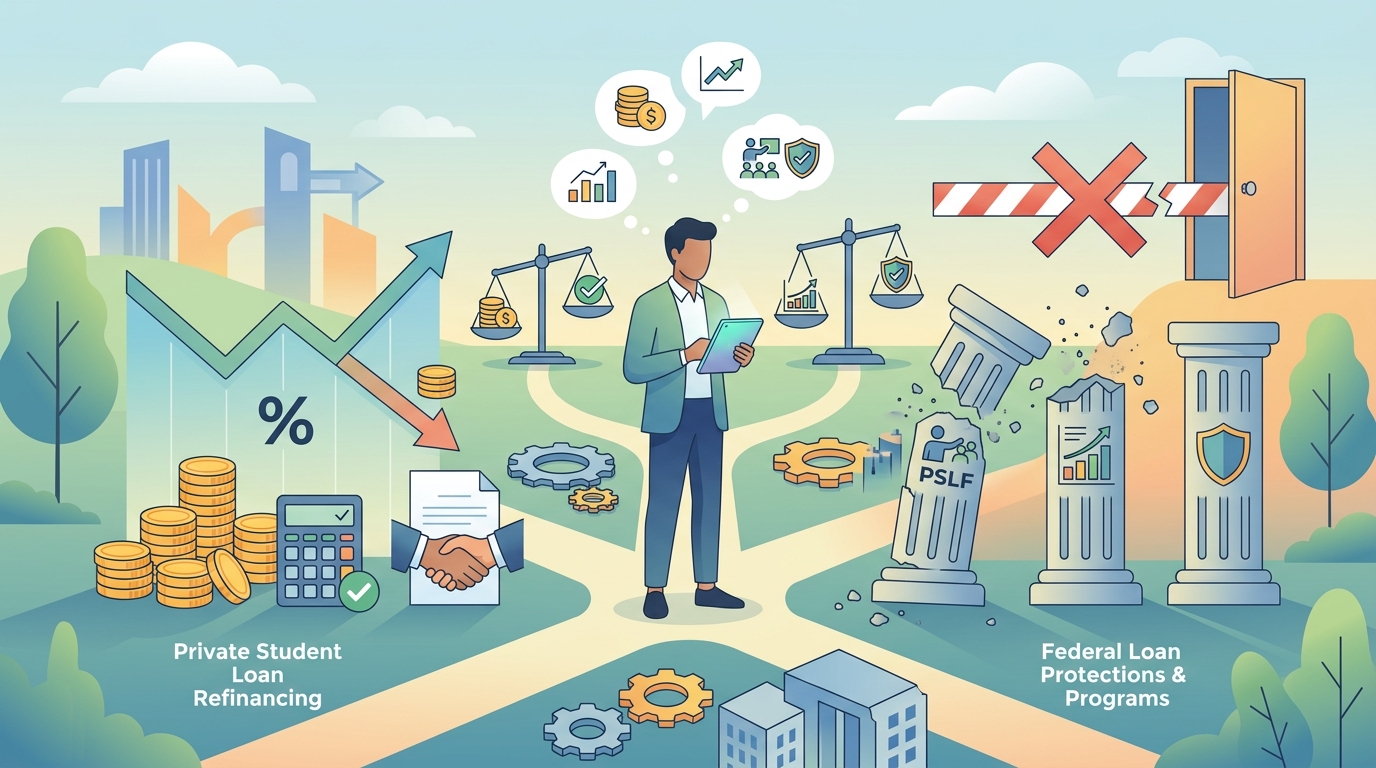
High-income earners considering student loan refinancing must carefully weigh interest rate reductions against the permanent loss of federal protections like income-driven repayment and PSLF.
The Financial Landscape of Private Student Loan Refinancing
High-earning professionals often hold significant educational debt balances accumulated during graduate, medical, dental, or legal training. When interest rates across commercial markets shift, refinancing these liabilities through private lending institutions becomes an appealing strategy to accelerate payoff timelines and lower total borrowing costs. Private student loan refinancing involves securing a new loan from a commercial entity—such as a private bank, credit union, or online lender—to clear one or more existing student debt accounts. According to consumer credit statistics published by the Federal Reserve Board (Source 4), interest rates across commercial lending products fluctuate based on broader economic conditions, central bank policy, and individual creditworthiness. While securing lower private student loan refinance rates can reduce monthly obligations, transferring debt out of the federal loan system introduces permanent financial trade-offs.
Refinancing is distinct from federal loan consolidation. Direct Loan Consolidation combines multiple federal student loans into a single federal loan with a fixed interest rate based on the weighted average of the original loans, preserving all federal statutory rights and flexible repayment structures. Conversely, private refinancing converts debt into a commercial contract. High earners must systematically evaluate whether nominal interest rate savings outweigh the total loss of federal safety nets, particularly when balancing debt payoff acceleration cost scenarios against potential economic shifts or career transitions.
Fixed vs. Variable Rate Mechanics in Shifting Macroeconomic Environments
Private financial institutions offer two primary interest rate structures for refinanced debt: fixed rates and variable rates. Selecting between these structures requires an understanding of interest rate mechanics during changing macroeconomic cycles. A fixed interest rate remains unchanged throughout the full duration of the loan term. This offers total payment predictability, locking in a static monthly obligation regardless of inflation trends or benchmark interest rate adjustments instituted by monetary authorities (Source 4). Fixed-rate products are structurally aligned with borrowers who intend to follow a standard or extended repayment schedule over seven to twenty years.
A variable interest rate shifts periodically according to an underlying financial benchmark index, such as the Secured Overnight Financing Rate (SOFR) or the Prime Rate. Variable-rate loans typically feature lower initial starting rates compared to fixed-rate alternatives, making them attractive to borrowers planning an aggressive debt payoff strategy over a short timeline. However, if macroeconomic conditions push benchmark indices upward, the interest rate on a variable loan escalates, resulting in higher monthly payment obligations and increased total interest expense. Borrowers choosing variable products generally aim to complete their payoff within one to three years to limit their exposure to rising interest rate cycles.
| Fixed Rate | Standard Commercial Base | None (Locked Rate) | Long-Term Repayer (7-20 Years) | Misses Savings If Market Rates Drop |
|---|---|---|---|---|
| Variable Rate | Discounted Entry Level | High (Indexed to SOFR/Prime) | Rapid Payoff Plan (1-3 Years) | Uncapped Monthly Payment Escalation |
Borrowers evaluating variable-rate contracts must review specific cap structures defined in loan agreements. Commercial contracts generally establish periodic rate caps, which limit how much an interest rate can rise in a single year, alongside lifetime rate caps that set the maximum allowable interest rate over the life of the loan. For example, a loan starting with a 5.0% variable rate with a 10.0% lifetime cap could experience a doubling of interest costs during persistent inflationary periods, neutralizing any initial cost savings achieved at origination.
Irreversible Loss of Federal Debt Safeguards
Refinancing federal loans into a private credit facility is an absolute, non-reversible financial transaction. Once a private lender pays off federal student loans, the borrower permanently forfeits all statutory protections established under Title IV of the Higher Education Act. The U.S. Department of Education maintains flexible repayment structures, legislative relief programs, and forgiveness frameworks that commercial institutions are under no obligation to duplicate (Source 1).
One of the most notable forfeitures is eligibility for Public Service Loan Forgiveness (PSLF). Federal rules dictate that PSLF cancels the remaining balance on Direct Loans after a borrower completes 120 qualifying monthly payments under an accepted repayment plan while working full-time for a qualifying government agency or 501(c)(3) non-profit organization (Source 2). Converting federal debt into a private loan permanently eliminates PSLF eligibility. Even if a high-earning physician, healthcare worker, or attorney currently works in the private sector, refinancing removes the option to transition to public service employment later in their career to claim tax-free debt cancellation (Source 2).
Furthermore, federal debt features statutory deferment and forbearance options, including administrative protections during national emergencies, economic hardship deferments, and unemployment relief. Private lenders may offer temporary hardship assistance at their own discretion, but these private programs are not guaranteed by law, typically restrict relief to short cumulative durations over the loan lifetime (such as 3 to 12 months total), and continue to accrue interest that capitalizes directly into the loan principal.
Comparing Income-Driven Repayment (IDR) and SAVE Plan Trade-Offs
Federal Income-Driven Repayment (IDR) options align monthly payment amounts with household adjusted gross income (AGI) and family size rather than total outstanding loan principal balances (Source 1). Federal plans such as the Saving on a Valuable Education (SAVE) plan, Pay As You Earn (PAYE), and Income-Based Repayment (IBR) cap monthly obligations at a specified percentage of discretionary income (Source 1). For high-income earners, monthly payments under IDR plans may equal or exceed standard 10-year repayment amounts when income is high. However, retaining IDR access serves as an essential financial insurance policy.
In the event of unexpected income decline, health challenges, or career interruption, an IDR structure automatically adjusts monthly payments downward—potentially to zero dollars per month—allowing the account to stay in good standing (Source 1). Private student loans lack dynamic income adjustment mechanisms. Private lenders require full contractual principal and interest payments each month regardless of job changes, industry contractions, or personal emergencies.
- Federal IDR Protections: Monthly obligations adjust based on annual tax filings and discretionary income metrics (Source 1).
- Interest Subsidies: Certain federal IDR structures eliminate unpaid monthly accrued interest under specific eligibility criteria (Source 1).
- Private Loan Rigidity: Monthly payments remain mandatory and fixed regardless of household cash flow changes.
- Long-Term Balance Cancellation: Federal IDR plans provide eventual forgiveness of remaining balances after 20 or 25 years of qualifying payments (Source 1).
Underwriting Standards: Credit Score, DTI, and Co-signer Rules
Private lenders determine interest rate offers through risk-based underwriting frameworks. Securing the lowest advertised interest rates requires meeting stringent credit, income, and debt ratio benchmarks. Commercial lenders analyze credit scores, debt-to-income (DTI) metrics, employment continuity, and unencumbered liquid reserves. Federal Reserve consumer credit reporting confirms that interest rate terms in commercial consumer credit markets reflect lender risk assessments (Source 4).
A FICO score of 760 or higher is typically required to qualify for top-tier fixed or variable interest rates. Applicants with credit scores between 680 and 740 may receive approval, but the assigned interest rates may equal or exceed existing federal direct loan rates, eliminating the primary economic reason to refinance.
Debt-to-income (DTI) ratios evaluate total monthly debt obligations relative to gross monthly earnings. Private lenders generally set maximum DTI thresholds between 35% and 45%, factoring in housing payments, vehicle loans, credit cards, and the proposed refinanced student loan. High earners with large educational debt relative to early-career gross income may face elevated DTI figures that hinder approval for competitive rates.
To satisfy strict underwriting criteria, applicants sometimes use a creditworthy co-signer. Adding a co-signer with strong credit credentials can lower the approved interest rate. However, co-signing establishes equal legal liability for the entire debt balance. Borrowers utilizing this path should confirm whether the lender offers a formal co-signer release provision. These provisions typically require 24 to 48 consecutive, full, on-time monthly payments and an independent credit check of the primary borrower before releasing the co-signer from legal responsibility.
Calculating Total Life-of-Loan Savings vs. Rate Reductions
Evaluating whether refinancing creates genuine financial value requires a comprehensive life-of-loan cost calculation rather than viewing nominal rate cuts in isolation. Securing a lower interest rate does not yield net savings if the repayment timeline is significantly extended.
Consider a practical scenario: A high earner has a $200,000 balance in federal student debt at a weighted average interest rate of 7.5% with 10 years remaining on the standard schedule. The monthly payment is approximately $2,374, leading to total interest charges of roughly $84,880 over 10 years, for a cumulative repayment total of $284,880.
If the borrower refinances that $200,000 balance into a 5-year private fixed loan at 5.0%, the monthly payment increases to approximately $3,774. However, total interest accrued over the shorter 5-year term drops to roughly $26,455, generating net interest savings of $58,425. Alternatively, if the borrower refinances that $200,000 into a 20-year private loan at 6.0% to reduce their monthly payment to $1,433, total interest rises to $143,985. Despite securing a 1.5% interest rate reduction (from 7.5% down to 6.0%), extending the term adds $59,105 in total interest relative to maintaining the original 10-year federal schedule.
| Original Federal Loans | $200,000 | 7.5% | 10 Years | $2,374 | $84,880 | $284,880 |
|---|---|---|---|---|---|---|
| Accelerated Private Refinance | $200,000 | 5.0% | 5 Years | $3,774 | $26,455 | $226,455 |
| Extended-Term Private Refinance | $200,000 | 6.0% | 20 Years | $1,433 | $143,985 | $343,985 |
This cost comparison demonstrates that calculating the debt payoff acceleration cost depends heavily on term length. High earners seeking maximum cash flow flexibility must analyze whether the long-term interest surcharge of an extended term offsets the immediate budget relief gained.
Prepayment Rules, Origination Fees, and Tax Deductibility Limits
Before finalizing a private refinancing agreement, borrowers must examine loan contracts for administrative costs and fee structures. Major private student loan refinancers generally do not charge prepayment penalties. This allows borrowers to make extra principal payments or clear balances entirely ahead of schedule without incurring fee penalties. However, borrowers should verify the absence of prepayment penalties directly in written loan disclosures.
Origination fees, application charges, and administrative processing fees vary across commercial lenders. An origination fee added to the loan balance increases the effective Annual Percentage Rate (APR) relative to the advertised nominal interest rate. Borrowers should prioritize zero-fee refinancing options to ensure upfront costs do not diminish interest rate savings.
Tax considerations also influence total net savings. Under Internal Revenue Service Topic No. 456 (Source 3), taxpayers may deduct up to $2,500 of student loan interest paid annually on qualified educational loans. However, this deduction is subject to strict modified adjusted gross income (MAGI) phase-out thresholds (Source 3).
For high-income earners whose MAGI exceeds the annual IRS phase-out limit, the student loan interest deduction is reduced or eliminated completely (Source 3). As a result, high earners cannot rely on tax deductions to offset interest costs, making nominal rate reductions and repayment term structures the primary drivers of net financial savings.
Can private refinanced student loans be transferred back into the federal loan system?
No. Once federal student loans are refinanced with a private lender, the debt becomes a commercial obligation. It cannot be consolidated back into a federal Direct Loan or regain federal protections, IDR options, or forgiveness rights (Source 1).
How does student loan refinancing affect an applicant's credit score?
Applying for refinancing generates a hard credit inquiry, which may cause a minor, temporary dip in credit scores. Opening a new loan account also alters the average age of accounts, though consistent on-time payments on the refinanced balance help establish positive credit history over time (Source 4).
Is refinanced student loan interest tax-deductible for high-income earners?
Interest paid on refinanced student loans remains qualifying interest under IRS guidelines, but the deduction is limited to $2,500 annually and phases out at higher MAGI levels (Source 3). High earners above the IRS income caps cannot claim the deduction regardless of whether the underlying loan is federal or private (Source 3).
Sources
- Income-Driven Repayment Plans — Federal Student Aid, U.S. Department of Education
- Public Service Loan Forgiveness (PSLF) — Federal Student Aid, U.S. Department of Education
- Topic No. 456 Student Loan Interest Deduction — Internal Revenue Service
- Consumer Credit (G.19) Statistics — Federal Reserve Board
This article is for general information only and is not professional advice. Figures come from public sources and change over time; check the official source before you act.
More from Inside Life Digest
- Gap Insurance Cost Breakdown: Pricing, Depreciation Curves, and When Coverage Is Necessary
- Long-Term Care Insurance Cost Breakdown: Premiums, Elimination Periods, and Benefit Triggers
- Evaluating Private Student Loan Refinancing: Interest Rate Mechanics, Federal Protection Losses, and Savings Calculus
- Comprehensive Travel Insurance: Medical Evacuation, Cancellation, and Pre-Existing Condition Waivers
- Revocable Living Trust vs. Will: Cost, Probate Avoidance, and Asset Transfer Rules
- Cyber Insurance Requirements for Small Businesses: Coverage Limits and Underwriting Criteria