Revocable Living Trust vs. Will: Cost, Probate Avoidance, and Asset Transfer Rules
A detailed side-by-side cost and legal analysis comparing revocable living trusts and traditional wills, including probate timelines, asset retitling, and tax rules.
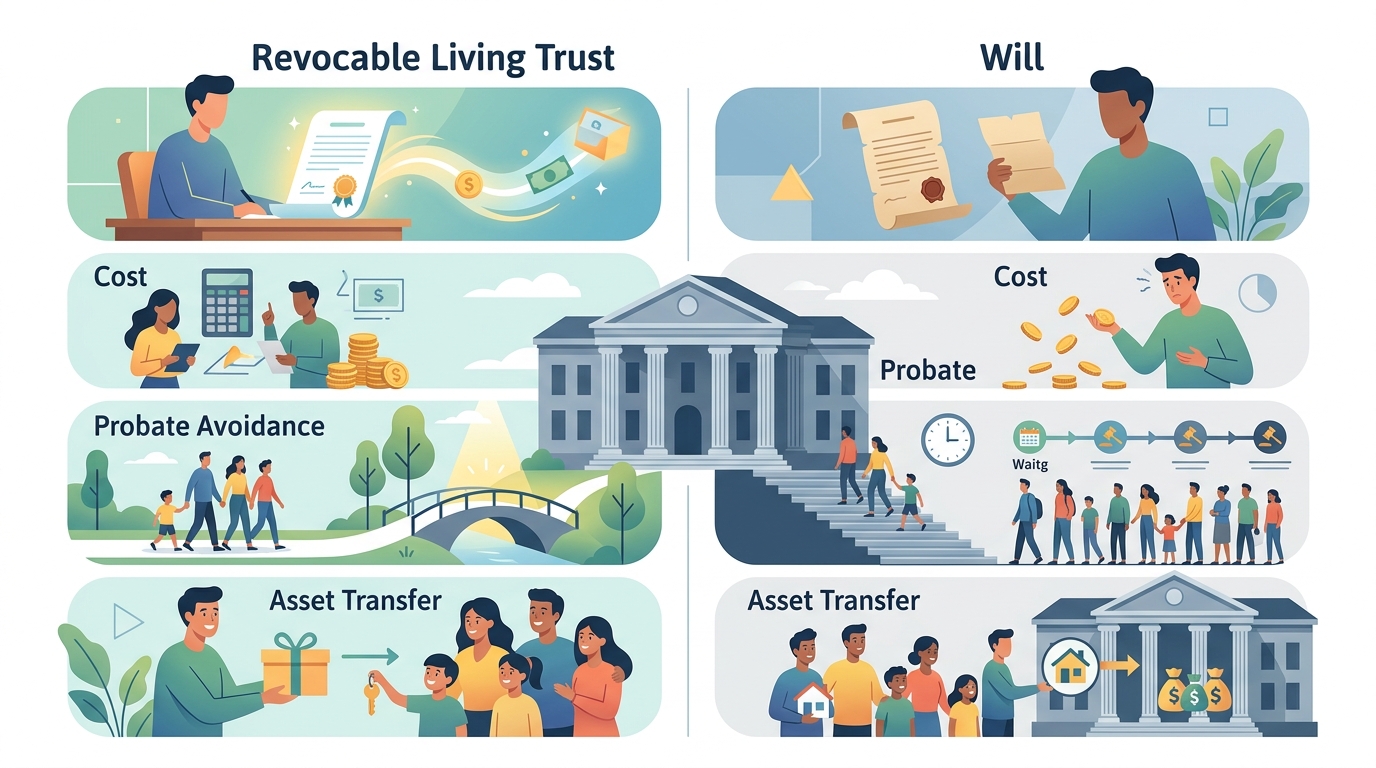
1. Understanding the Fundamentals: Revocable Living Trusts vs. Last Wills
Estate planning centers on two primary legal instruments for directing the distribution of assets after death: the last will and testament, and the revocable living trust. Both instruments allow individuals to designate who receives real estate, bank accounts, investments, and personal property. However, they operate under distinct legal frameworks and offer different mechanisms for asset management during lifetime and after death.
A last will and testament is a legal document that takes effect only after the creator (the testator) dies. It names an executor to oversee the settling of the estate and outlines how property should be distributed. A key feature of a will is that it requires court supervision through the probate process to validate the document, clear debts, and transfer title to beneficiaries. A will also allows parents to nominate legal guardians for minor children.
In contrast, a revocable living trust is a legal entity created during the grantor's lifetime. The grantor transfers ownership of assets into the trust, serving as the initial trustee with full control to manage, buy, or sell trust property. The trust document designates a successor trustee who takes over management if the grantor becomes incapacitated or passes away. Because property held in trust is legally owned by the trust entity rather than the individual at the time of death, these assets pass directly to named beneficiaries without passing through probate court.
2. Upfront Costs: Legal Setup Fees and Document Preparation
The initial financial investment required for an estate plan varies significantly depending on whether an individual chooses a simple will package or a comprehensive revocable living trust. Attorney fee structures, geographic location, and estate complexity heavily influence these upfront expenses.
Creating a standard last will generally involves lower initial legal fees. State bar association fee surveys indicate that an estate planning attorney typically charges between $300 and $1,000 for a basic will package. This package usually includes a simple will, a financial power of attorney, and an advance healthcare directive. For married couples, basic double-will packages often range from $500 to $1,500.
Establishing a revocable living trust requires more extensive drafting and administrative work. Attorney fee schedules for a basic trust package typically range from $1,500 to $3,500 for individuals and $2,000 to $5,000 for couples. This package includes the trust agreement, a pour-over will (which acts as a safety net for un-funded assets), powers of attorney, and healthcare directives. The initial setup fee also covers attorney guidance for deed transfers and asset assignment.
| Planning Instrument | Typical Upfront Attorney Fee Range | Included Documents | Initial Administrative Complexity |
|---|---|---|---|
| Simple Will Package | $300 – $1,500 | Will, Financial Power of Attorney, Living Will | Low (Standard questionnaire and execution) |
| Revocable Living Trust Package | $1,500 – $5,000 | Trust Agreement, Pour-Over Will, Power of Attorney, Directives, Initial Deed Drafting | Moderate to High (Requires asset transfers and deed retitling) |
3. The Public Probate Process: Timelines, Court Fees, and Privacy Concerns
The primary practical distinction between a will and a living trust lies in how assets are processed after death. A will must go through state probate court, whereas assets held in a properly funded revocable trust bypass probate completely.
Probate is a court-supervised legal procedure designed to validate a will, inventory assets, resolve creditor claims, and distribute the remaining property to heirs. State court administrative data shows that formal probate proceedings typically take between 9 and 24 months to complete, depending on court dockets, estate complexity, and family disputes. During this period, beneficiaries may experience delayed access to estate funds.
Court filing fees, executor commissions, statutory attorney fees, and appraisal costs are paid out of the estate during probate. State fee schedules estimate that total probate administration costs routinely absorb 3% to 7% of the estate's gross value before distributions are made to beneficiaries.
- Public Record Access: Probate court filings are public records. Anyone can inspect the will, inventory of assets, debts, and the names and addresses of beneficiaries.
- Out-of-State Real Estate (Ancillary Probate): If an individual owns real property in multiple states, a will must undergo separate ancillary probate proceedings in each state where real estate is located.
- Privacy Protection of Trusts: Trust agreements are private legal contracts. Asset transfers conducted via a trust occur privately without court filings or public disclosure of beneficiary allocations.
4. Funding a Living Trust: Retitling Deeds, Accounts, and Beneficiary Rules
Creating a trust agreement is only the first step in establishing a functional living trust. To avoid probate, the trust must be funded. Funding is the formal process of transferring ownership of personal property, real estate, and financial accounts from the individual's name into the name of the trust.
To retitle real estate, the grantor must execute and record a new deed—such as a quitclaim deed or grant deed—transferring the property from the individual owner to the trustee of the living trust. County recorder offices charge nominal filing fees, typically ranging from $20 to $100 per deed, to record these ownership changes.
Financial accounts, including bank checking, savings, and taxable brokerage accounts, must be updated directly with financial institutions. Banks require proof of the trust's existence, usually satisfied by providing a Certificate of Trust, to change account titles. Certain assets, such as retirement accounts (IRAs, 401ks) and life insurance policies, generally should not be deeded to the trust directly due to tax rules; instead, the trust or specific individuals are designated as primary or contingent beneficiaries on the institution's official forms.
If a grantor executes a trust document but fails to retitle assets into the trust's name before death, those unfunded assets remain subject to probate administration under the terms of a pour-over will.
5. Incapacity Planning and Fiduciary Responsibilities
Estate planning addresses management of financial affairs during life as well as distribution after death. Both living trusts and durable powers of attorney provide mechanisms for managing assets in the event of cognitive decline, illness, or temporary incapacity.
Under a revocable living trust, if the grantor becomes unable to manage financial matters, a designated successor trustee assumes management of all trust assets without court intervention. The Consumer Financial Protection Bureau notes that trustees act as legal fiduciaries, requiring them to manage trust property strictly in the beneficiary's best interest, avoid conflicts of interest, keep trust assets separate from personal funds, and maintain accurate records (Source 2).
If an individual relies solely on a simple will, incapacity planning requires a separate financial power of attorney document. The designated agent under a power of attorney also carries fiduciary responsibilities under state law (Source 2). However, some financial institutions show reluctance to accept older power-of-attorney forms, occasionally forcing family members to petition a court for legal guardianship or conservatorship to manage non-trust assets.
6. Estate Tax Considerations and Wealth Transfer Rules
A common misconception is that a revocable living trust automatically reduces or eliminates federal estate tax liability. Under federal tax law, revocable living trusts do not provide inherent tax exemption because the grantor retains complete control and revocation rights over trust assets during life.
According to the Internal Revenue Service, gross estate calculation includes all property owned or controlled by the decedent at the time of death, including assets held in a revocable living trust (Source 1). Federal estate tax law applies a basic exclusion amount to taxable estates, which is indexed annually for inflation (Source 1). Estate tax returns must be filed for gross estates that exceed the statutory exemption threshold in the year of the individual's death (Source 1).
While simple revocable trusts do not alter estate tax math, specialized irrevocable trust structures or specific credit shelter trust provisions embedded within revocable trust documents can help married couples maximize their combined federal tax exemptions (Source 1). For the vast majority of estates below federal and state tax thresholds, the decision between a trust and a will is driven by administrative probate avoidance rather than direct tax reduction.
7. When a Simple Will Is Economically and Legally Sufficient
Despite the privacy and probate avoidance advantages of revocable living trusts, a simple will remains an economically rational choice for many individuals and families.
A standard will package may be legally and economically sufficient under specific financial and family circumstances:
- Single-State Modest Assets: Individuals who own no real estate or own property in a single state with total assets falling under state-specific small estate probate thresholds.
- Simplified Transfer Designations: Estate owners who can pass the majority of their assets via Transfer-on-Death (TOD), Payable-on-Death (POD), or joint tenancy designations directly through financial institutions.
- Young Families with Primary Focus on Guardianship: Parents of minor children whose main legal objective is naming legal guardians, where complex asset management rules are not yet required.
- Low Initial Budget Constraints: Individuals who prefer lower upfront legal expenditures and accept that probate administrative costs will be settled by the estate later.
8. Summary Comparison of Estate Planning Vehicles
| Feature / Consideration | Last Will and Testament | Revocable Living Trust |
|---|---|---|
| Primary Purpose | Directs asset distribution after death | Manages assets during life and after death |
| Probate Requirement | Subject to state court probate | Bypasses court probate if fully funded |
| Privacy Level | Public court record upon filing | Private contract (not filed in court) |
| Out-of-State Real Estate | Requires ancillary probate per state | Avoids multi-state probate via deed retitling |
| Incapacity Management | Requires separate Power of Attorney | Successor trustee manages trust property directly |
| Upfront Legal Fees | Lower ($300 – $1,500) | Higher ($1,500 – $5,000) |
| Post-Death Administrative Costs | Higher (Court costs, executor & legal fees) | Lower (Minimal court fees, direct distribution) |
Does a revocable living trust protect assets from creditors during my lifetime?
No. Because the grantor retains full ownership and control over a revocable living trust, state laws generally treat trust assets as personal property. Creditors can reach assets in a revocable trust to satisfy debts during the grantor's lifetime.
Do I still need a will if I have a revocable living trust?
Yes. A trust package usually includes a specialized pour-over will. This document acts as a safety net to catch any assets accidentally left out of the trust and ensures they are transferred into the trust upon death. A will is also necessary to nominate legal guardians for minor children.
How long does it take to transfer assets to beneficiaries through a living trust?
Asset distribution through a revocable living trust often begins within weeks or months after death, following basic administrative tasks like settling final bills and taxes. In contrast, standard probate distributions through a will typically take between 9 and 24 months.
Sources
- Estate and Gift Taxes — Internal Revenue Service
- Managing Someone Else's Money Guides — Consumer Financial Protection Bureau
This article is for general information only and is not professional advice. Figures come from public sources and change over time; check the official source before you act.
More from Inside Life Digest
- Gap Insurance Cost Breakdown: Pricing, Depreciation Curves, and When Coverage Is Necessary
- Long-Term Care Insurance Cost Breakdown: Premiums, Elimination Periods, and Benefit Triggers
- Evaluating Private Student Loan Refinancing: Interest Rate Mechanics, Federal Protection Losses, and Savings Calculus
- Comprehensive Travel Insurance: Medical Evacuation, Cancellation, and Pre-Existing Condition Waivers
- Revocable Living Trust vs. Will: Cost, Probate Avoidance, and Asset Transfer Rules
- Cyber Insurance Requirements for Small Businesses: Coverage Limits and Underwriting Criteria